
Executive Summary: When malware cripples your Windows system, downloading files in Safe Mode can be your most powerful recovery tool. Safe Mode creates a minimal, controlled environment where most malicious software cannot activate, allowing you to securely retrieve antivirus installers, critical drivers, and diagnostic utilities. This comprehensive guide walks you through every stage of the process—from booting into Safe Mode with Networking, to verifying file integrity, to installing protective software like 360 Total Security—while also equipping you with proactive strategies to prevent ever needing this emergency measure again.
Why Downloading Files in Safe Mode Can Be a Security Lifeline
Most users only think about Safe Mode when something has already gone wrong. But understanding why this stripped-down Windows environment offers a genuine security advantage transforms it from a last resort into a deliberate, strategic tool. Safe Mode benefits extend far beyond simple troubleshooting—it creates a malware isolation barrier that normal mode simply cannot replicate, giving you a controlled environment to perform secure downloads when your system is at its most vulnerable.
The Core Security Principle of Safe Mode
Safe Mode’s security power comes directly from its minimalism. According to Microsoft’s official documentation on Safe Mode startup, Windows in this state loads only the essential drivers and services required for basic system operation. This architectural constraint has profound security implications:
- Malware dormancy: The vast majority of malware—including trojans, rootkits, and ransomware—relies on auto-start registry entries, scheduled tasks, or third-party service hooks to activate at boot. Safe Mode bypasses these entirely, leaving most infections dormant and powerless.
- Clean network pathway: When an active infection is suppressed, it cannot intercept your network traffic, redirect DNS queries, or corrupt files mid-download. This creates a fundamentally cleaner network pathway than anything achievable in a compromised normal-mode session.
- Reduced attack surface: With fewer processes running, there are fewer execution contexts for malware to exploit, inject into, or leverage for privilege escalation during your download session.
This combination of factors means that even if your normal Windows session is heavily compromised, a properly executed Safe Mode session can provide a relatively clean slate for retrieving the tools you need to fight back.
Common Scenarios Requiring This Approach
Knowing when to deploy this strategy is as important as knowing how. The following are the most common and critical scenarios where downloading files in Safe Mode becomes not just useful, but essential:
- Antivirus installer retrieval: A sophisticated infection may disable, corrupt, or uninstall your existing security software as its first act. Downloading a fresh antivirus installer—such as 360 Total Security—in Safe Mode allows you to bypass the malware’s defenses and bring a clean security tool onto the system.
- Driver and patch recovery: Malware can corrupt system drivers, causing hardware failures, blue screens, or network outages. Fetching a clean, manufacturer-verified driver in Safe Mode with Networking lets you restore functionality without risk of re-infection during the download.
- Diagnostic tool acquisition: Specialized utilities like malware removal tools, rootkit scanners, or system integrity checkers must be obtained from trusted sources. Safe Mode ensures these tools arrive on your system unmodified and untampered.
Step-by-Step Guide: Entering Safe Mode for Secure Downloads
Successfully booting into the correct type of Safe Mode is the foundational first step. Critically, you need Safe Mode with Networking—not standard Safe Mode—because you require internet access to download files. There are two primary methods: a planned approach for when your system is still partially functional, and an emergency approach for more severe situations. Both are straightforward and require no technical expertise.
Method 1: Using System Configuration (msconfig) — The Planned Approach
This method is ideal when your system can still boot into Windows normally and you want to schedule a Safe Mode session in advance.
Step 1: Press Win + R to open the Run dialog, type msconfig, and press Enter to launch the System Configuration utility.
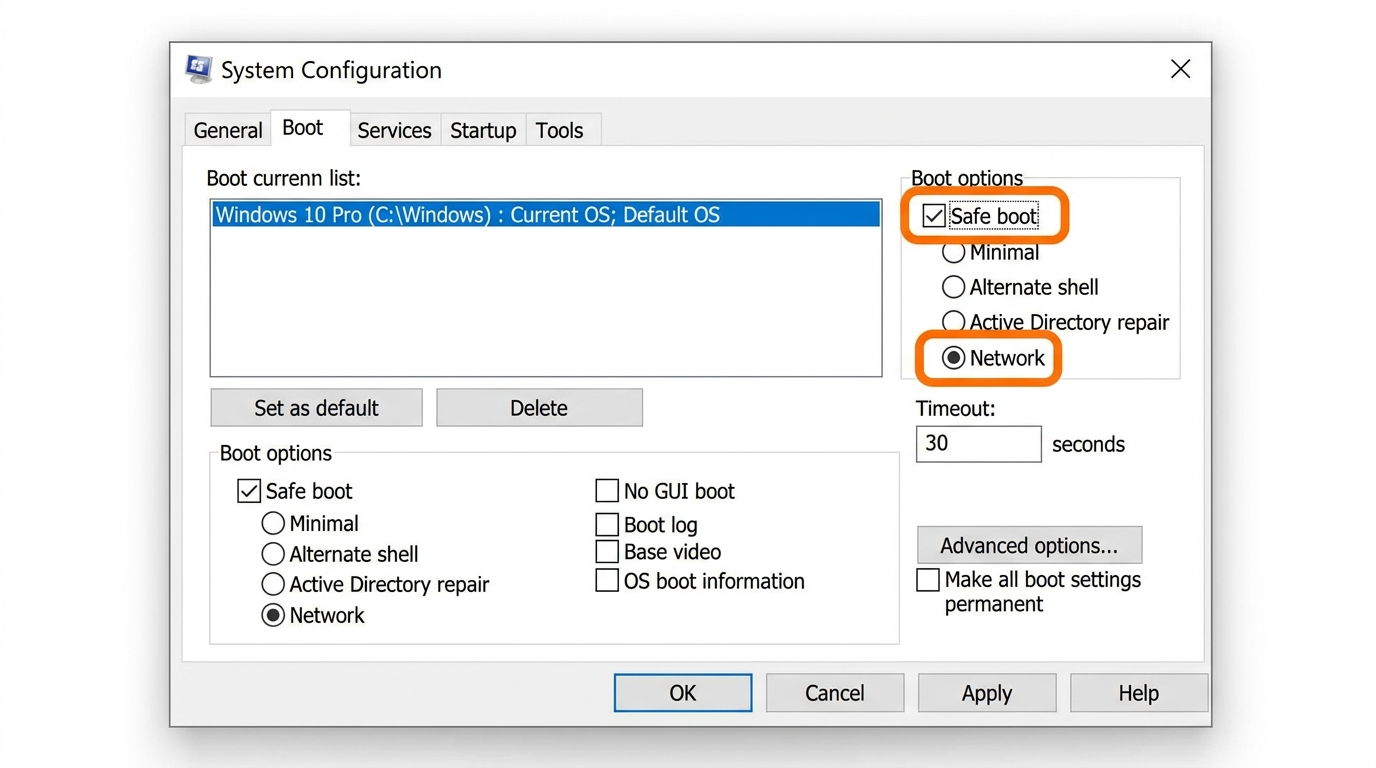
Step 2: Navigate to the Boot tab. Under “Boot options,” check the “Safe boot” checkbox, then select the “Network” radio button beneath it. Click Apply, then OK.
Step 3: Restart your computer. Windows will automatically boot into Safe Mode with Networking.
⚠️ Critical Reminder: After completing your download and remediation tasks, you must return to msconfig and uncheck the “Safe boot” option before restarting. Failing to do so will cause your computer to continuously boot into Safe Mode.
Method 2: Using Recovery/Startup Settings — The Emergency Approach
Use this method when your system is too unstable to access msconfig, or when you need to enter Safe Mode immediately without a pre-planned restart.
For Windows 10 and Windows 11:
- Open Settings (Win + I) and navigate to Update & Security (Windows 10) or System > Recovery (Windows 11).
- Under Advanced startup, click “Restart now.”
- After the system reboots to the blue recovery screen, select Troubleshoot.
- Select Advanced options, then Startup Settings, then click Restart.
- When the Startup Settings menu appears, press F5 to select “Enable Safe Mode with Networking.”
Alternative emergency trigger: If Windows cannot boot at all, interrupt the boot process three consecutive times (by holding the power button during startup). Windows will automatically enter the Recovery Environment, from which you can follow steps 3–5 above.
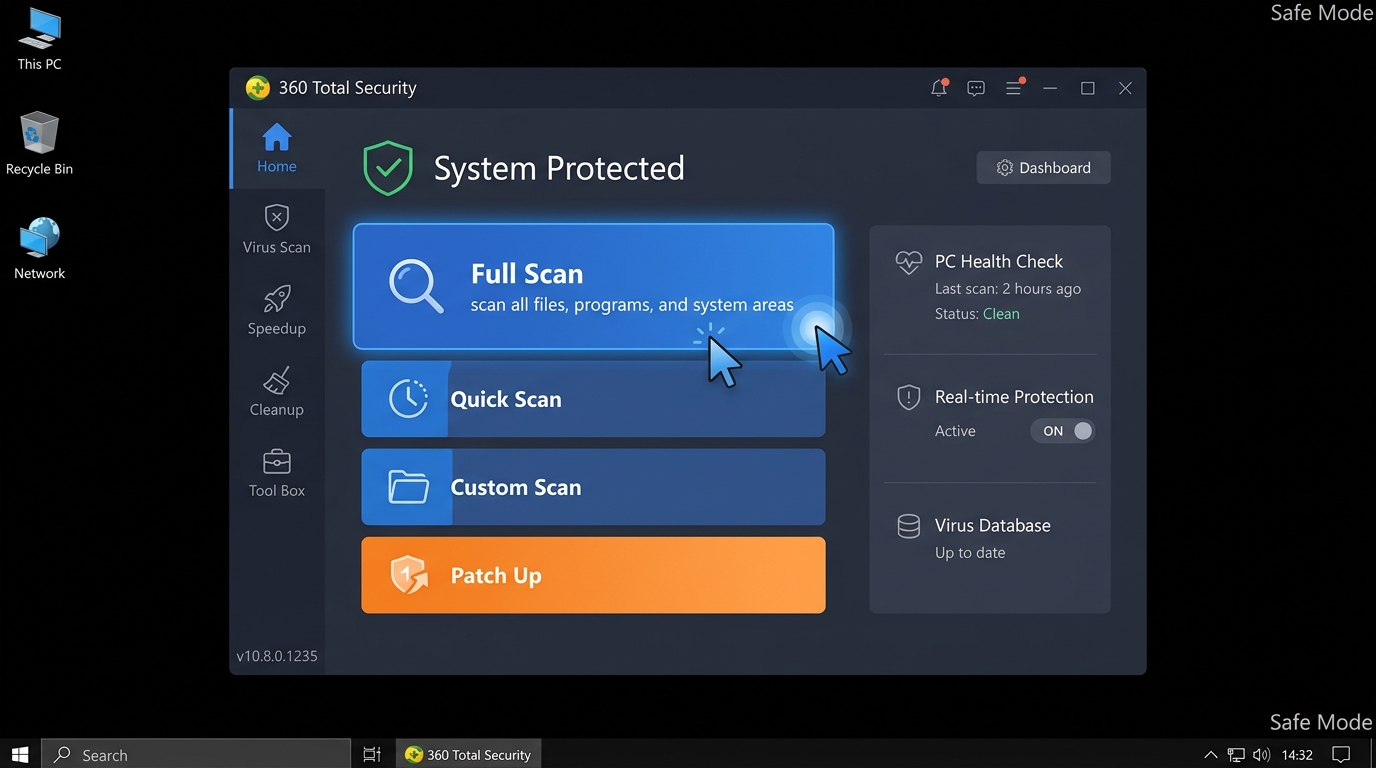
Once your desktop loads in Safe Mode with Networking, you will notice a black desktop background and the words “Safe Mode” displayed in each corner of the screen. Your network connection will be active, and you are ready to proceed with secure downloads.
How to Actually Download a File Safely Once in Safe Mode
Entering Safe Mode is only the beginning. The download process itself demands heightened vigilance. The isolated environment you have created is only as secure as the choices you make within it. The core principle is strict minimalism: access only trusted sources, use only essential tools, and verify everything before execution. Safe browsing in this context is not optional—it is the entire point of the exercise.
Choosing and Using Your Download Tool
Your browser choice in Safe Mode matters more than you might expect. Follow these guidelines to minimize risk:
- Use built-in or pre-existing browsers: Microsoft Edge is pre-installed on all modern Windows systems and is the safest default choice in Safe Mode. Internet Explorer (on older systems) is also acceptable. Avoid downloading and installing a new browser just for this session—that introduces unnecessary variables.
- Disable all extensions: Before navigating to any download source, open your browser’s extension or add-on manager and disable every extension. Their behavior in Safe Mode’s limited environment is unpredictable, and a compromised extension could undermine your entire secure download effort.
- Use private/incognito mode: This prevents any cached credentials or cookies from a compromised normal session from being loaded into your Safe Mode browser session.
“In Safe Mode, simplicity is security. Use the most basic, trusted application available to minimize variables. Every additional component you introduce is another potential point of failure or exploitation.”
— IT Security Consultant, Enterprise Threat Response Division
Identifying and Accessing Trusted Download Sources
The source of your download is the single most important security decision you will make in this process. A clean download environment means nothing if you retrieve a malicious file from an untrusted source.
- Official vendor websites only: Navigate directly to the manufacturer’s or developer’s official domain. For Microsoft tools, use microsoft.com. For hardware drivers, use the manufacturer’s official support page (e.g., intel.com, nvidia.com, dell.com). Type the URL directly into the address bar—do not use search engine results, which can be manipulated through SEO poisoning attacks.
- Antivirus software downloads: For antivirus software like 360 Total Security, navigate directly to its official global portal. A key advantage of 360 Total Security in this scenario is that its core scanning engine and virus definition database are architected to operate effectively even within Safe Mode’s limited service environment, making it an excellent choice for Safe Mode remediation.
- Avoid all third-party aggregator sites: According to a 2026 Cybersecurity Threat Intelligence Report, over 35% of all malware infections are traced back to fake or unauthorized third-party download portals—sites with names containing words like “soft,” “download,” “free,” or “crack.” These sites frequently bundle legitimate software with hidden malware payloads. In Safe Mode, with your defenses already compromised, visiting such a site is an unacceptable risk.
- Verify the URL before clicking anything: Look for HTTPS, check the exact domain spelling (beware of typosquatting like “micros0ft.com” or “360totalsecurity-download.net”), and confirm the padlock icon is present and valid.
Post-Download: Critical Verification and Installation Steps
The file is now on your hard drive, but your work is not done. A file that appears legitimate could still be a trojanized version if it was intercepted, corrupted, or sourced from a compromised mirror. Before executing anything, you must verify file integrity. Then, you need a deliberate strategy for installation—because when and how you run the file in your Safe Mode session can determine the success or failure of your entire recovery effort.
Verifying File Integrity Before Execution
File integrity verification using cryptographic hash checking is the gold standard for confirming that a downloaded file is exactly what the publisher intended. Most reputable software vendors publish official SHA-256 checksums on their download pages.
Using PowerShell to check a file’s hash (Windows built-in, no installation required):
# Replace the path with your actual file location
Get-FileHash -Path "C:\Downloads\setup.exe" -Algorithm SHA256

# Example output:
# Algorithm       Hash                                                                   Path
# ---------       ----                                                                   ----
# SHA256          A3F5B2C1D9E8F7A6B5C4D3E2F1A0B9C8D7E6F5A4B3C2D1E0F9A8B7C6D5E4F3A2  C:\Downloads\setup.exe

# Compare the Hash value above with the checksum published on the official website.
# If they match exactly, the file is authentic and unmodified.
Copy the output hash and compare it character-by-character with the value listed on the official source website. Any discrepancy—even a single character—means the file has been modified and should be deleted immediately.
Understanding which hash algorithm to use and trust is important. The following table provides a clear comparison:
| Hash Algorithm | Hash Length | Security Level | Current Recommendation | Notes |
|---|---|---|---|---|
| MD5 | 128-bit (32 hex chars) | ⚠️ Weak | Not recommended for security verification | Vulnerable to collision attacks; use only for basic corruption checks |
| SHA-1 | 160-bit (40 hex chars) | ⚠️ Deprecated | Avoid for critical files | Officially deprecated by NIST; known theoretical weaknesses |
| SHA-256 | 256-bit (64 hex chars) | ✅ Strong | Recommended standard | Current industry gold standard; used by Microsoft, major antivirus vendors |
Always prefer SHA-256 verification when the option is available. If the vendor only provides MD5, treat it as a basic sanity check rather than a security guarantee.
The Safe Installation and Run Strategy
With the file verified, your installation strategy depends on what type of file you downloaded:
- For antivirus installers (e.g., 360 Total Security): Run the installer directly within your Safe Mode with Networking session. 360 Total Security is designed to initiate installation and perform a preliminary scan even within Safe Mode’s limited service environment. This is the optimal approach because the malware is still dormant—you want to identify, quarantine, and neutralize threats before they have a chance to reactivate in a normal boot session.
- For system drivers or Windows patches: Note the file’s saved location (e.g.,
C:\Downloads\driver_v2.1.exe). Drivers often require a full Windows environment with all services running to install correctly. In this case, complete your antivirus scan first to clean the system, then reboot into normal mode and install the driver from the saved location. - Immediate full scan protocol: After installing your security software in Safe Mode, initiate a full system scan immediately—before exiting Safe Mode. Scanning while malware is dormant dramatically increases detection rates and ensures that threats are quarantined before they can react to the security software’s presence.
- Post-remediation reboot: Once the scan is complete and threats are quarantined or removed, reboot into normal Windows. If you used the msconfig method to enter Safe Mode, remember to uncheck the “Safe boot” option first.
Proactive Defense: How to Avoid Ever Needing This Emergency Measure
The procedures outlined in this guide are powerful, but they represent a reactive response to a problem that should ideally never occur. The most effective security strategy is one that makes Safe Mode downloads unnecessary in the first place. Building proactive security habits—anchored by robust real-time protection—is the difference between a user who occasionally battles infections and one who rarely encounters them. Prevention is always more efficient than remediation.
Employing Robust Real-Time Antivirus Protection
A comprehensive real-time antivirus solution is the cornerstone of proactive malware prevention. Not all security software is equal in this regard. Consider the following comparison:
| Security Feature | 360 Total Security | Windows Defender (Basic) |
|---|---|---|
| Real-Time File Scanning | ✅ Multi-engine (Avira + QVM AI + 360 Cloud) | ✅ Single engine |
| Download Protection | ✅ Scans files during active download process | ⚠️ Scans after download completes |
| Web Shield / URL Blocking | ✅ Blocks malicious URLs before page loads | ⚠️ Basic SmartScreen filter only |
| Ransomware Protection | ✅ Dedicated ransomware behavior shield | ✅ Controlled folder access (manual setup required) |
| System Performance Optimization | ✅ Built-in cleanup and speed tools | ❌ Not included |
| Sandbox / Isolation | ✅ Isolated execution environment for suspicious files | ❌ Not available in standard version |
360 Total Security monitors file downloads, web activity, and system behavior continuously, intercepting threats at the moment of entry rather than after they have already executed. Features like Download Protection scan files during the download process itself—not just after they land on your disk—providing a critical temporal advantage over traditional post-download scanning approaches.
Ensure that all real-time shields are enabled and that your virus definition database is set to update automatically. According to a 2025 Global Endpoint Security Report, systems running outdated virus definitions are 4.7 times more likely to experience a successful malware infection than those with current definitions.
Cultivating Safe General Computing Habits
Technology alone cannot compensate for risky human behavior. The following habits, practiced consistently, dramatically reduce your exposure to malware:
- Official sources, always: Download software exclusively from official vendor websites or verified platform stores. Pop-up advertisements offering software, unsolicited email attachments, and social media links to downloads are among the most common infection vectors. Treat any unsolicited download prompt with extreme suspicion.
- Maintain a rigorous update schedule: Keep your Windows operating system, all installed applications, and especially your antivirus software (360 Total Security) fully updated. A 2026 Vulnerability Exploitation Report found that over 60% of successful malware attacks exploited known vulnerabilities for which patches had already been available for more than 30 days. Updates are not optional maintenance—they are active security measures.
- Avoid high-risk content categories: “Cracked” or “keygen” versions of paid software, pirated games from unofficial sources, and torrented media files are statistically among the highest-risk download categories. These files frequently contain bundled malware that is deliberately obfuscated to evade detection. No software is worth the risk of a full system compromise.
- Use strong, unique passwords and enable two-factor authentication: Many malware infections begin with compromised credentials. Protecting your accounts reduces the risk of attackers using your own systems against you.
- Back up your data regularly: A reliable backup strategy (following the 3-2-1 rule: three copies, two different media types, one offsite) means that even in a worst-case infection scenario, your data is recoverable without paying ransoms or suffering permanent loss.
The combination of a proactive security tool like 360 Total Security and disciplined computing habits creates a layered defense that makes system-level infections rare events rather than recurring crises. Visit the official website today to download 360 Total Security for your Windows or macOS desktop and establish your proactive security baseline before an emergency forces you into Safe Mode.
Frequently Asked Questions
Q1: Can I use any browser to download files in Safe Mode with Networking?
Yes, but with important caveats. Microsoft Edge is the recommended choice on Windows 10 and 11 as it is pre-installed and maintained by Microsoft. You should disable all browser extensions before browsing and use incognito/private mode to avoid loading data from a potentially compromised normal session. Avoid downloading and installing a new browser specifically for your Safe Mode session, as this introduces unnecessary complexity and risk.
Q2: Will Safe Mode with Networking guarantee that my download is virus-free?
Safe Mode with Networking significantly reduces the risk of download interception by suppressing most active malware. However, it does not guarantee the safety of the file itself—that depends entirely on the trustworthiness of the source. Always download from official vendor websites, verify URLs carefully, and perform a SHA-256 hash check after downloading to confirm file integrity before execution.
Q3: Can I install 360 Total Security directly in Safe Mode?
Yes. 360 Total Security is designed to support installation and core scanning operations within the Safe Mode with Networking environment. This is actually the recommended approach when your normal system is compromised, as it allows the antivirus to detect and quarantine dormant threats before they can reactivate. After the scan is complete, reboot into normal mode to allow 360 Total Security to finalize its installation and full feature activation.
Q4: What should I do if my computer cannot boot into Windows at all to access Safe Mode?
If Windows cannot complete a normal boot, you can trigger the Windows Recovery Environment by interrupting the boot process three consecutive times using the power button. Alternatively, boot from a Windows installation USB drive and select “Repair your computer” to access recovery options. From the Recovery Environment, navigate to Troubleshoot > Advanced Options > Startup Settings to access Safe Mode with Networking.
Q5: How do I know if the malware on my system will be suppressed in Safe Mode?
The vast majority of common malware—including adware, spyware, trojans, and most ransomware variants—relies on Windows startup mechanisms (registry run keys, scheduled tasks, third-party services) that are not loaded in Safe Mode. However, highly sophisticated rootkits that modify core system files or the boot sector may persist even in Safe Mode. If you suspect a rootkit infection, consider using a bootable rescue disk (such as those provided by major antivirus vendors) which operates entirely outside of Windows for the deepest level of scanning.
Author Bio: This article was written by a Senior Technical Security Writer with over a decade of experience in cybersecurity content, endpoint protection strategy, and Windows system architecture. Specializing in translating complex security concepts into actionable guidance for both technical and non-technical audiences, the author has contributed to enterprise security documentation, threat response playbooks, and consumer cybersecurity education platforms. Content is reviewed against current Microsoft technical documentation and industry-standard security frameworks.
Learn more about 360 Total Security