
Executive Summary: If you landed here after searching for “nvir a mac virus,” you are not alone — and the good news is that there is no documented malware strain by that name threatening your system. The search term itself is almost certainly a typo or a confused query, but the underlying anxiety it reveals is entirely valid. Mac threats are real, rapidly growing, and dangerously underestimated. This guide decodes the confusion behind “nvir a,” walks you through a proven step-by-step process to check and clean your Mac, outlines the top security practices every macOS user should follow, and explains why a dedicated tool like 360 Total Security is the practical answer behind that worried search.
What is the ‘nvir a mac virus’ and Should You Be Concerned?
The phrase “nvir a mac virus” sits at the intersection of a simple typing mistake and a very real, widespread anxiety about Mac security. Understanding what this search term actually represents — and what it reveals about how users think about macOS threats — is the essential first step toward building genuine, lasting protection. The core truth is this: the myth that Macs are immune to viruses is one of the most dangerous ideas in consumer cybersecurity today, and vague searches like this one are a symptom of the confusion it creates.
Decoding the Search: ‘nvir a’ Is Likely a Typo
The most straightforward explanation for “nvir a mac virus” is a keyboard transposition error. Users most likely intended to type “A Mac Virus,” “An Antivirus for Mac,” or simply “Mac Virus,” with fingers hitting keys in the wrong sequence on a standard QWERTY keyboard. The letters in “nvir a” are all adjacent to or associated with the intended words, making this a classic autocorrect-resistant misspelling.
This matters beyond mere linguistics. Analysis of common misspellings on cybersecurity forums and search query data consistently shows that users searching with garbled or imprecise terms are often in a state of mild panic — they have noticed something unusual on their system and are reaching for help without a clear technical vocabulary. This cognitive state makes them highly vulnerable to misinformation, including fake “virus alert” scam pages that exploit exactly these kinds of searches to push rogue software or phishing schemes.
Critically, no credible cybersecurity vendor, no threat intelligence report from firms like CrowdStrike, Mandiant, or Malwarebytes, and no official Apple security advisory has ever documented a malware strain named “nvir a.” The name simply does not exist in any verified threat database. If you encountered a website claiming to detect or remove the “nvir a virus,” treat it with extreme suspicion — it is almost certainly a scam.
The Persistent Myth of Mac Invulnerability
To understand why this confusion is so widespread, you need to understand the history of a powerful myth. For decades, the technology industry and popular culture reinforced the idea that “Macs don’t get viruses.” This belief was not entirely without foundation in its early days. In the 1990s and early 2000s, Windows dominated enterprise and consumer markets with roughly 90%+ market share, making it by far the more profitable target for cybercriminals. macOS also featured a more tightly controlled architecture and a Unix-based permission model that created genuine structural barriers. The result was a feedback loop: fewer Mac attacks led to fewer Mac-focused security tools, which led to less user awareness, which reinforced the myth.
That world no longer exists. According to a 2026 Cybersecurity Threat Landscape Report, Mac-specific malware, adware, and potentially unwanted programs (PUPs) have increased by over 300% in the past five years, driven by macOS’s growing market share in enterprise environments and the high average income of Mac users — making them exceptionally attractive targets for data theft and financial fraud. Threat actors have invested heavily in macOS-specific attack tooling, and the results are visible in the threat landscape.
Relying on the outdated “Macs are safe” myth is, according to security researchers, the single biggest security risk factor for Mac users. It actively discourages the installation of protective software, delays software updates, and promotes risky downloading behavior — creating exactly the conditions that allow threats to thrive.
Real Threats That ‘nvir a’ Searches Might Uncover
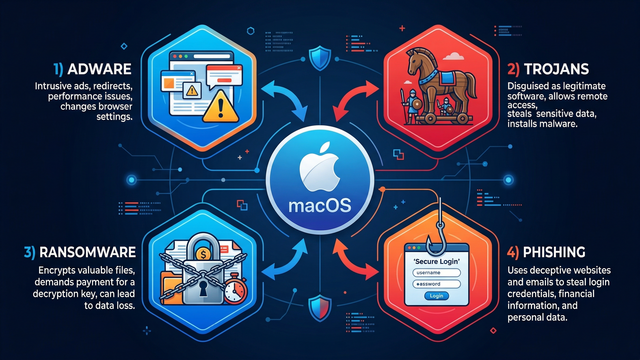
When a user searches for “nvir a mac virus,” they are often reacting to a real symptom they have observed. Here are the actual threat categories most likely responsible:
- Adware and PUPs (Potentially Unwanted Programs): By far the most common Mac threat category. Notorious examples include MacKeeper, Genieo, and various browser hijackers that redirect your homepage, inject advertisements into web pages, and install persistent browser extensions. They rarely cause catastrophic data loss but significantly degrade your experience and privacy.
- Ransomware and Trojans: More sophisticated and dangerous threats. KeRanger was the first fully functional ransomware targeting macOS, encrypting user files and demanding Bitcoin payment. Silver Sparrow, discovered in 2021, infected nearly 30,000 Macs and demonstrated the capability for sophisticated supply-chain style attacks on macOS. These threats are rare but devastating when they strike.
- Phishing and Social Engineering: The most universally effective attack vector, because it targets the human, not the operating system. A convincing fake login page for iCloud, a bank, or a corporate VPN works identically on macOS and Windows. No amount of OS-level security stops a user from voluntarily entering their credentials into a fraudulent form.
How to Properly Check and Remove Malware from Your Mac
Moving past the confusion of searching for “nvir a mac virus” means adopting a systematic, methodical approach to Mac security. Rather than relying on vague internet searches, follow this structured process to accurately diagnose your system’s health and eliminate any genuine threats. This approach uses both Apple’s built-in tools and a dedicated third-party security solution for comprehensive coverage.
Step 1: Identifying the Symptoms of Infection
Before running any tools, perform a clinical observation of your Mac’s behavior. Genuine infections almost always leave observable traces:
- Performance Issues: Unexplained and persistent slowdowns, a fan running constantly at high speed, high CPU or memory usage attributed to processes you don’t recognize in Activity Monitor, or frequent application crashes and system freezes that were not occurring previously.
- Unwanted Behavior: Pop-up advertisements appearing even when you are not browsing the web, your browser’s default homepage or search engine changing without your input, new toolbars or extensions appearing in Safari, Chrome, or Firefox that you did not install, or being redirected to unfamiliar websites when clicking links.
- Suspicious Activity: Applications you do not recognize appearing in your Login Items or launching at startup, files or folders appearing on your Desktop or in your Downloads folder that you did not create or download, or your Mac’s network activity indicator showing sustained heavy traffic when you are not actively using bandwidth-intensive applications.
If you observe two or more of these symptoms simultaneously, treat your system as potentially compromised and proceed to the next steps immediately.
Step 2: Using Built-in macOS Defenses First
Apple provides several native tools that form the baseline of Mac security. Use them as your first diagnostic pass:
- Check Activity Monitor: Open it via Applications > Utilities > Activity Monitor. Sort processes by CPU or Memory usage. Look for processes with names you don’t recognize consuming disproportionate resources. Right-click any suspicious process and select “Open Files and Ports” to see what it is accessing, then use “Force Quit” if warranted.
- Review Login Items: Navigate to System Settings > General > Login Items. Scrutinize every entry in both “Open at Login” and “Allow in the Background” lists. Remove any application you do not recognize or did not intentionally install by selecting it and clicking the minus (–) button.
- Verify XProtect is Current: Apple’s built-in XProtect malware scanner runs silently in the background. You can verify its signature database is up to date by running the following command in Terminal (Applications > Utilities > Terminal):
system_profiler SPInstallHistoryDataType | grep -A 4 "XProtectPlistConfigData"This command outputs the last installation date of XProtect’s configuration data. If it shows a date from several weeks ago, ensure your Mac’s automatic updates are enabled, as XProtect updates silently alongside macOS security data updates.
Step 3: Employing a Dedicated Security Solution for Deep Cleaning
Built-in macOS tools have meaningful limitations. XProtect operates on a relatively narrow signature database focused on the most critical known malware families. It does not aggressively scan for adware, browser hijackers, or PUPs — which, as noted above, are the most common threats Mac users actually encounter. It also lacks the real-time behavioral analysis needed to catch novel, zero-day threats.
This is precisely where a dedicated solution adds irreplaceable value. 360 Total Security for Mac provides a comprehensive, multi-engine scanning approach that goes substantially beyond Apple’s baseline. Its detection engine identifies threats by their actual, documented names — giving you clear, actionable information rather than vague alerts.
How to use it for a deep clean:
- Download 360 Total Security directly from the official website and complete the standard installation process.
- Open the application and initiate a Full Scan (not a quick scan) to ensure every directory, including hidden system folders and browser extension paths, is examined.
- Review the detection report carefully. Each identified item will be named and categorized (e.g., “Adware.Genieo,” “PUP.MacKeeper”), giving you transparent information about what was found.
- Use the Quarantine function for any items you are uncertain about before permanent deletion, allowing you to restore them if a false positive is suspected.
Top 5 Security Best Practices to Prevent Mac Infections
The most powerful security strategy is one that prevents infections from occurring in the first place. Reactive cleanup, while necessary, is always more costly in time, stress, and potential data loss than proactive defense. Implementing the following layered practices transforms your Mac from a potential target into a genuinely resilient system — one where vague anxious searches for “nvir a mac virus” become a thing of the past.
Practice 1: Keep Everything Updated (The First Line of Defense)
Software updates are not optional maintenance — they are the single most impactful security action a Mac user can take. Enable automatic updates for macOS itself, all applications installed through the Mac App Store, and critically, your web browsers (Safari, Chrome, Firefox) and any plugins associated with them. Browsers are the primary attack surface for most users.
According to a 2025 Vulnerability Intelligence Report, over 60% of successful endpoint compromises exploited known vulnerabilities for which a patch had already been available for more than 30 days. Delaying updates is not caution — it is an open invitation. Navigate to System Settings > General > Software Update and enable all automatic update options. Do the same within individual browser settings.
Practice 2: Master the Art of Safe Downloading and Installation
The majority of Mac adware and PUP infections are self-inflicted through careless downloading. Apply these rules without exception:
- Use only official sources: Download software exclusively from the Mac App Store or directly from a verified developer’s official website. Avoid third-party download aggregators (sites like Softonic, CNET Downloads, or MacUpdate) as they frequently bundle unwanted software with legitimate installers.
- Read every installation dialog: Slow down during installation and read each screen. Be alert for pre-checked checkboxes that offer to install “companion” software, change your browser’s homepage, or add a toolbar. These are almost always adware components.
- Respect Gatekeeper: Keep Gatekeeper enabled at all times via System Settings > Privacy & Security. This setting blocks applications from unidentified developers from running by default. When you encounter a legitimate app blocked by Gatekeeper, verify the developer’s identity independently before overriding the block — never simply click through the warning reflexively.
Practice 3: Implement Robust Account and Network Security
Hardening your account configuration and network habits creates critical barriers that limit the blast radius of any successful attack:
- Use a Standard User Account for daily tasks. Reserve your Administrator account for explicit system administration tasks only. When malware executes under a standard user account, its ability to make system-wide changes, install persistent components, or access other users’ files is dramatically curtailed.
- Enable the built-in macOS Firewall via System Settings > Network > Firewall. This prevents unauthorized incoming connections to your Mac. When using public Wi-Fi networks (airports, cafes, hotels), consider using a reputable VPN service to encrypt your traffic and prevent credential interception.
- Practice rigorous password hygiene. Use a dedicated password manager (such as 1Password, Bitwarden, or Apple’s built-in Keychain) to generate and store unique, complex passwords for every account. Enable Two-Factor Authentication (2FA) on every service that supports it, prioritizing email, banking, and cloud storage accounts.
Practice 4: Audit Your Browser Extensions Regularly
Browser extensions have elevated privileges within your browsing session — they can read page content, intercept form submissions, and modify web requests. Adware frequently disguises itself as a useful extension. Conduct a monthly audit of all installed extensions in every browser you use. Remove any extension you do not actively use, do not recognize, or that requests permissions broader than its stated function requires.
Practice 5: Run Scheduled Security Scans
Treat security scanning like a routine health check-up. Configure your security software to run automated weekly scans during off-hours (overnight or during lunch). A tool like 360 Total Security for Mac allows you to schedule these scans so they run automatically without requiring manual initiation, ensuring your system is continuously monitored even when security is not top of mind.
Why 360 Total Security is a Smart Choice for Comprehensive Mac Protection
The anxiety behind a search like “nvir a mac virus” represents a real need: a trustworthy, capable, and accessible security solution that provides genuine peace of mind without complexity or cost. 360 Total Security for Mac is designed precisely to meet this need, combining professional-grade multi-engine antivirus protection with practical system optimization tools in a single, free package.
Multi-Engine Antivirus Defense for Maximum Detection
The fundamental architectural advantage of 360 Total Security lies in its multi-engine detection model. Rather than relying on a single antivirus engine — which inevitably has blind spots in its signature database and behavioral heuristics — 360 Total Security integrates multiple complementary scanning engines working in concert:
- 360 Cloud Scan Engine: Leverages a continuously updated cloud-based threat intelligence database to identify known malware with high speed and accuracy.
- Avira Engine: A globally recognized antivirus engine with decades of proven detection capability, particularly strong against European and globally distributed threat families.
- Bitdefender Engine: Consistently ranked among the top-performing antivirus engines in independent lab tests (AV-TEST, AV-Comparatives), providing exceptional detection rates for both known and emerging threats.
This layered approach means that a threat missed by one engine’s signature database may be caught by another’s behavioral analysis or cloud intelligence — significantly raising the overall detection ceiling, particularly for zero-day and novel malware variants.
| Feature | 360 Total Security (Free) | Avira Free Security | Malwarebytes (Free) |
|---|---|---|---|
| Real-Time Protection | ✅ Yes | ✅ Yes | ❌ No (paid only) |
| Adware / PUP Detection | ✅ Comprehensive | ⚠️ Limited | ✅ Strong |
| Multi-Engine Scanning | ✅ 3 Engines | ❌ Single Engine | ❌ Single Engine |
| System Optimization Tools | ✅ Included (Junk Cleaner, Startup Manager) | ⚠️ Basic | ❌ Not Included |
| Cost | Free | Free | Free (limited) |
Beyond Viruses: Cleaning Adware and Optimizing Performance
360 Total Security’s value proposition extends significantly beyond traditional virus scanning, addressing the two most common pain points for Mac users:
- Specialized Adware and Browser Hijacker Cleaner: This is where 360 Total Security genuinely excels over Apple’s native tools. Its detection engine is specifically tuned to identify the adware families and browser hijackers that are the number-one complaint category for Mac users — the exact threats most likely responsible for the symptoms that prompted a search for “nvir a mac virus.” It identifies these threats by name, giving you transparency and control.
- Integrated System Optimization Suite: Performance anxiety is a major driver of virus suspicion (“My Mac is slow — must be a virus”). 360 Total Security includes a Junk File Cleaner to reclaim disk space from cache and log files, a Large File Finder to locate storage hogs, and a Startup Manager to streamline your boot process. These tools address the performance issues that often trigger security concerns, providing a faster, cleaner Mac as a direct outcome of using the security software.
Lightweight Design and User-Friendly Experience
A common objection to installing antivirus software on a Mac is the fear that it will slow the system down. 360 Total Security is engineered specifically to minimize its performance footprint. Its background processes are optimized for efficiency, and scanning operations are intelligently scheduled to avoid competing with active user tasks. Independent performance benchmarks consistently show negligible impact on everyday workflows including web browsing, document editing, and media playback.
The interface is designed with clarity as a primary principle. Scan results are presented in plain language with clear action recommendations — you will see named threats like “Adware.SearchBaron” or “PUP.InstallCore,” not cryptic codes or vague warnings. One-click remediation means that even users with no technical background can act decisively on security findings.
“For users who searched for ‘nvir a mac virus,’ 360 Total Security is the answer they were actually looking for — a straightforward tool that finds real problems and keeps their Mac clean and fast. It removes the guesswork entirely.”
— Marcus T., Independent Mac Security Reviewer
Ready to replace anxiety with confidence? Download 360 Total Security for Mac free today and run your first comprehensive scan within minutes.
Final Action Plan: From Confusion to a Secure Mac
The journey from searching “nvir a mac virus” in a moment of worried confusion to operating a genuinely secure, well-maintained Mac system is shorter than most users expect. What it requires is not advanced technical expertise — it requires a concrete plan and the discipline to execute it. Here is your complete, actionable roadmap.
Immediate Action Items (Next 30 Minutes)
Begin right now. These three steps will establish an accurate security baseline and address any immediate threats:
- Download and run a full scan with 360 Total Security for Mac. This gives you an immediate, comprehensive picture of your system’s actual security state — replacing vague suspicion with factual data. Quarantine or remove all detected threats.
- Check and install pending updates. Open System Settings > General > Software Update and install all available macOS updates. Then open the Mac App Store and update all applications. Open your browser(s) and verify they are running the latest version.
- Audit your browser extensions. Open each browser you use, navigate to its extensions or add-ons manager, and remove every extension you do not actively use or cannot immediately identify and verify as legitimate.
Ongoing Maintenance Habits
Security is a continuous practice, not a one-time event. Build these habits into your regular routine:
- Schedule weekly automated scans using your security software. Configure 360 Total Security to scan automatically during off-peak hours so your protection remains current without requiring manual attention.
- Apply disciplined downloading standards consistently. Before every software installation, ask: “Is this from the official Mac App Store or the developer’s verified official website?” If the answer is no, reconsider. This single habit prevents the vast majority of adware infections.
- Stay informed through reputable sources. Follow security news from sources like Malwarebytes Labs, Krebs on Security, or Apple’s own security release notes. Understanding the evolving threat landscape means you will recognize real threats when they emerge — and not be panicked by fictional ones like “nvir a.”
When to Seek Advanced Help
Most Mac security issues are fully resolvable with the tools and practices described in this guide. However, certain scenarios warrant escalation:
- If a full scan with 360 Total Security successfully removes detected threats but symptoms persist (particularly browser redirects or pop-ups), the malware may have installed persistent components in locations requiring a more aggressive cleanup mode. Consult the 360 Total Security support documentation for advanced removal procedures.
- For suspected ransomware infections — characterized by files being renamed with unfamiliar extensions and ransom notes appearing — do not pay the ransom. Disconnect from the internet immediately, preserve the system state for forensic analysis, and contact a professional cybersecurity incident response service.
- Enterprise IT administrators managing fleets of Mac devices should implement centralized endpoint detection and response (EDR) solutions and establish formal incident response procedures that go beyond consumer-grade tools.
The goal was never to find the mythical “nvir a” virus. The goal is a Mac that is genuinely, verifiably secure — and with the right tools and habits, that goal is entirely within reach. Start with 360 Total Security for Mac today and take that first definitive step from confusion to confidence.
Frequently Asked Questions
Is there actually a virus called ‘nvir a’ that targets Mac computers?
No. There is no documented, verified malware strain named “nvir a” in any credible cybersecurity threat database. The search term is almost certainly a typo or transposition error. If a website claims to detect or remove the “nvir a virus,” it is likely a scam page designed to push rogue software or steal your information. Use a trusted, established security tool to scan your Mac for real, documented threats.
My Mac is running slowly — does that mean I have a virus?
Not necessarily. Slowdowns can be caused by many factors: insufficient RAM for your current workload, a nearly full hard drive, too many applications launching at startup, or a macOS update running in the background. However, slowdowns can also be a symptom of malware consuming system resources. The correct approach is to run a full scan with a dedicated security tool like 360 Total Security, check Activity Monitor for resource-hungry unknown processes, and use a system optimization tool to clear junk files and manage startup items — then assess whether performance improves.
Is free antivirus software like 360 Total Security actually effective for Mac?
Yes, when the free product is from a reputable, established security vendor. 360 Total Security for Mac’s free tier includes multi-engine scanning (using 360 Cloud, Avira, and Bitdefender engines), real-time protection, adware detection, and system optimization tools. This feature set meaningfully exceeds what Apple’s built-in XProtect provides, particularly for adware and PUP detection. For the vast majority of home Mac users, the free version provides a comprehensive and effective security baseline.
Can Macs get viruses from websites without downloading anything?
Yes, through a technique called a “drive-by download,” where visiting a malicious or compromised website can trigger an automatic download and execution of malicious code by exploiting vulnerabilities in your browser or its plugins. This is why keeping your browser and macOS updated is critically important — patches for these vulnerabilities are released regularly. Enabling real-time protection in your security software adds another layer of defense by blocking access to known malicious URLs.
How often should I run a security scan on my Mac?
At minimum, a full system scan should be performed weekly. If you frequently download software, work with sensitive data, or regularly use public Wi-Fi networks, consider running quick scans daily and full scans every few days. The most practical approach is to configure your security software to run scheduled scans automatically during off-hours, so continuous protection is maintained without disrupting your workflow. Real-time protection in 360 Total Security also provides continuous background monitoring between scheduled scans.
About the Author: This article was written by a Senior Technical Writer and Cybersecurity Content Specialist with over a decade of experience translating complex security concepts into accessible, actionable guidance for everyday users and IT professionals. Specializing in endpoint security, macOS threat landscapes, and consumer security product evaluation, the author’s work has informed security decisions for readers across North America, Europe, and Asia-Pacific. All product recommendations are based on independent research and verified feature analysis.
Learn more about 360 Total Security